When Atmosphere Becomes The Experience
My first reaction to this photograph was surprisingly simple.
I liked the sky.
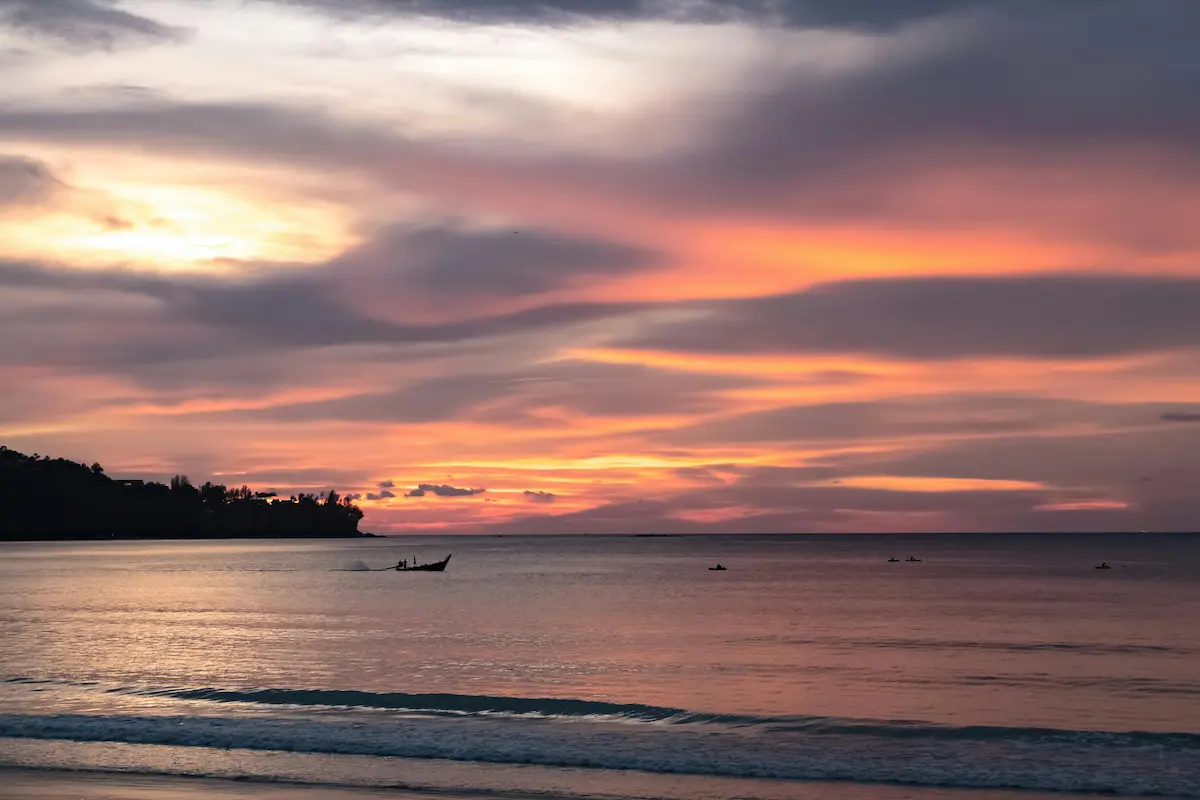
Before I noticed the boat, before I looked at the water, and before I paid much attention to the details scattered across the lower half of the frame, my attention was drawn almost entirely toward the layered colours stretching across the horizon.
The photograph immediately creates a sense of atmosphere. Soft oranges, yellows, and fading blues blend together through textured cloud formations, creating the kind of scene that photographers naturally find difficult to ignore. In many ways, this is exactly the sort of image that demonstrates why atmosphere in photography can be so appealing. The colours feel calm, the light feels gentle, and the transition between day and night creates a mood that is easy to enjoy.
Yet what interested me most was not what I noticed while looking at the image.
It was what I remembered afterwards.
If somebody had shown me the photograph and then taken it away a few minutes later, I suspect my memory would have been dominated by the sky. I would have remembered the colours, the cloud textures, and the feeling of dusk settling across the scene. What I probably would not have remembered immediately was the small boat moving across the water below.
That observation became the reason I chose this image for analysis.
Because the more time I spent studying the photograph, the more I found myself wondering about the relationship between atmosphere and attention. Why did the sky become my dominant memory of the image? Why did the boat initially feel secondary despite containing much of the scene’s human interest? And what does that tell us about atmosphere in photography more broadly?
For me, those questions became far more interesting than the sunset itself.
When the Sky Becomes the Memory
One of the things I find most interesting about this photograph is not what I saw while looking at it, but what I remembered afterwards.
If somebody showed me the image for a few seconds and then took it away, I suspect my recollection would be dominated almost entirely by the sky. I would remember the layered colours, the textured clouds, and the soft transition between daylight and dusk. The atmosphere would remain clear in my mind long after the smaller details had faded.
The boat, however, would probably not.
That is an interesting outcome because the boat arguably contains more narrative potential than any other element within the frame. It introduces movement, human presence, and the possibility of a story. Yet despite all of that, my attention initially remained fixed on the sky.
Part of this comes down to visual weight.
The sky occupies a significant portion of the frame and contains the strongest colour contrast. The layered oranges and yellows immediately separate themselves from the cooler blues above and the darker tones below. The cloud formations add texture, while the brighter area toward the upper left naturally attracts attention. Even before we consciously analyse the image, our eyes are already being directed upward.
In many ways, this demonstrates one of the strengths of atmosphere in photography.
Atmosphere often works quickly.
Before we understand a subject, identify a story, or explore the details within a frame, we frequently respond to mood. Light, colour, weather, and environmental conditions create an emotional impression long before we begin analysing what is actually happening in the photograph.
That is exactly what happened here.
The atmosphere became my first experience of the image.
The challenge is that atmosphere can sometimes become so dominant that it overshadows everything else. The sky becomes the memory. The colours become the memory. The mood becomes the memory.
And while those elements are undeniably important, they do not always create the deepest connection.
Looking at this image, I found myself asking a simple question.
What happens after the atmosphere has captured my attention?
Because that is often where a photograph either deepens or begins to fade.
Beautiful, But From a Distance
The more I thought about this photograph, the more I realised that my reaction was not really emotional.
I enjoyed the colours.
I appreciated the atmosphere.
I found the sky visually appealing.
But I did not immediately feel connected to the scene itself.
That distinction is important because atmosphere and connection are not always the same thing.
A photograph can be beautiful without being immersive. It can create mood without creating participation. It can attract attention without necessarily encouraging the viewer to step inside the experience.
I think that is partly what happened here.
The sky creates a strong first impression. The colours feel calm, the cloud textures add interest, and the fading light creates the kind of atmosphere that naturally attracts photographers. There is very little visual chaos within the frame, which allows the mood to emerge clearly and without distraction.
Yet despite all of that, I initially found myself remaining outside the photograph.
I was looking at it rather than feeling part of it.
The atmosphere was something I observed rather than something I experienced.
What makes this interesting is that atmosphere in photography often gets discussed as though it automatically creates emotional connection. In reality, atmosphere is usually only the beginning of the conversation. It creates the conditions for connection, but it does not necessarily guarantee it.
Many photographs succeed in creating mood.
Far fewer succeed in making viewers feel present.
Looking back at my own reaction, I think that is why the image stayed in my mind. Not because the colours were particularly dramatic, but because they raised a question.
Why was I remembering the atmosphere so clearly while feeling relatively detached from the scene itself?
At that point, I found myself looking away from the sky and paying closer attention to what was happening on the water below.
That is where the photograph began to change.
The Boat I Almost Missed
What makes this photograph particularly interesting to analyse is that the element I found myself thinking about most was not the element I noticed first.
Initially, the boat barely registered.
I knew it was there. I recognised that there was activity taking place on the water, but compared to the sky, it felt secondary. The colours dominated my attention so completely that everything beneath them seemed to play a supporting role.
Yet the longer I studied the image, the more my attention began shifting downward.
I started noticing the boat more clearly.
Then I noticed the small spray of water trailing behind it.
Suddenly the boat was no longer sitting on the water.
It was moving through it.
That small detail changed the way I interpreted the scene entirely.
Movement introduces possibilities. The moment we recognise that something is travelling rather than simply existing, questions begin to appear naturally. Where is the boat going? Is it returning home after a day on the water? Is it carrying fishermen back toward shore? Is it simply crossing the bay beneath a beautiful evening sky?
The photograph never answers those questions.
What matters is that it encourages them.
That is often where atmosphere in photography begins evolving into something more engaging. The image stops being entirely about mood and starts creating room for imagination.
What I find particularly interesting is that the boat occupies very little space within the frame. Compared to the sky, it is almost insignificant. Yet it contains far more narrative potential than the clouds above it.
The sky tells me how the evening looked.
The boat begins to suggest how the evening might have felt.
That distinction became increasingly important the longer I spent with the image.
At first, I was admiring the atmosphere.
Now I was beginning to imagine the experience.
And for me, that is where the photograph starts becoming much more interesting.
Small Subject, Bigger Story
One of the reasons I kept returning to the boat is because it challenged something that photographers often assume about visual importance.
We tend to think the largest or most dominant element within a photograph must also be the most important.
This image suggests otherwise.
The sky occupies a significant portion of the frame. It contains the strongest colours, the greatest visual weight, and the most immediate sense of atmosphere. It is the element that initially attracts attention and ultimately becomes the strongest memory of the photograph.
Yet it is the boat that I find myself thinking about.
That contrast is fascinating.
The boat occupies only a small area of the scene, but it introduces something the sky cannot provide on its own. It creates a human connection to the environment. Even though the people aboard are little more than silhouettes, their presence changes how the photograph is read.
Without the boat, the image remains a study of light, colour, and atmosphere.
With the boat, the image begins hinting at experience.
This is something I have noticed repeatedly when studying atmosphere in photography. Atmospheric conditions often attract our attention, but smaller subjects frequently provide the emotional anchor that helps us connect with the scene. They give us a reference point. A way of imagining ourselves within the environment rather than simply observing it from a distance.
The boat also creates scale.
The vast sky suddenly feels larger because something human exists beneath it. The open water feels more expansive because somebody is moving across it. The colours feel less abstract because they now belong to a moment being experienced by real people rather than existing as a purely visual display.
That relationship matters.
The atmosphere provides the setting.
The boat provides the possibility of participation.
I think this is why I found the image becoming more engaging over time. The sky remained beautiful, but beauty alone was no longer carrying the photograph. The small boat began introducing something deeper. Not a complete story, and not even a clearly defined narrative, but enough human presence to encourage imagination.
And sometimes that is all a photograph needs.
Not a dramatic subject.
Not a complex story.
Just a small element that allows viewers to step beyond admiration and begin imagining themselves inside the scene.
What Keeps Me Outside the Frame?
Despite everything the boat adds to the photograph, I still find myself experiencing the image more as an observer than a participant.
That feeling is difficult to explain at first because there is nothing obviously wrong with the composition. The atmosphere works well, the colours are attractive, and the boat introduces enough human presence to create curiosity. Yet even after noticing those elements, I remain aware that I am looking at the scene from a distance.
Part of that may come from the dominance of the sky.
The atmosphere is so visually strong that it naturally becomes the primary experience of the photograph. My attention continues returning to the colours, the cloud textures, and the fading light above the horizon. While those elements are undeniably beautiful, they also create a degree of separation. I admire them more than I engage with them.
The boat, meanwhile, occupies a much smaller role within the visual hierarchy.
Once I noticed it, my eye began moving between the boat and the smaller objects scattered across the water. The photograph became more interesting, but I still never felt completely drawn into the experience taking place below the sky.
I also found myself thinking about the lower portion of the frame.
The water provides balance and contrast, but it does not strongly pull me into the scene. Instead of leading me toward the boat, it functions more as a foundation beneath the atmosphere above. The result is that much of the visual energy remains concentrated in the upper half of the photograph.
That observation became particularly interesting when I experimented with a tighter crop.
The moment the boat became more prominent, my relationship with the image changed. I began noticing the movement more clearly. The spray behind the boat became easier to see. The possibility of a journey became easier to imagine.
Most importantly, I started feeling less like a spectator.
I started imagining what it might feel like to be there.
For me, that shift highlights something important about atmosphere in photography. Atmosphere may attract us to an image, but connection often depends on where the photograph encourages us to place ourselves. The original composition gives me a beautiful scene to admire. The tighter composition begins giving me an experience to imagine.
And those are not always the same thing.
A Different Way to See the Scene
One of the most useful things about studying photographs is that it allows us to experiment with possibilities.
Not because there is always a right answer, but because alternative interpretations often reveal what we were responding to in the first place.
When I looked at a tighter crop of this image, I found my reaction changing almost immediately.
The atmosphere remained.
The colours remained.
The cloud textures remained.
Nothing about the mood of the scene disappeared.
Yet the experience felt noticeably different.
The boat became easier to notice.
The movement became easier to notice.
Even the small trail of water behind the boat became more significant because it now occupied a larger role within the frame. Instead of simply existing beneath the sky, the boat began participating in the photograph more actively.
What I found most interesting was not the visual change itself.
It was the emotional change.
The original image encouraged me to admire the atmosphere.
The tighter version encouraged me to imagine the experience.
That distinction may seem subtle, but I think it sits at the heart of what makes certain photographs more immersive than others.
The crop did not create a story.
The story was already there.
The boat was already moving across the water. The atmosphere was already present. The possibility of a journey already existed within the scene.
What changed was the balance of attention.
The photograph began placing slightly more emphasis on the element that allowed me to imagine myself within the environment rather than simply observe it from afar.
I think this is an important lesson when discussing atmosphere in photography because atmosphere is often treated as the destination rather than the starting point.
Beautiful light can attract us.
Interesting weather can attract us.
Colour can attract us.
But those elements do not automatically create connection.
Connection often emerges when atmosphere combines with something that encourages participation. A subject, a detail, a gesture, a movement, or a small human element that helps viewers imagine what it might feel like to stand where the photograph was made.
Looking at the two versions, I do not necessarily think one is right and the other is wrong.
What I do think is that they create different experiences.
One invites admiration.
The other invites imagination.
And for me, that difference became one of the most interesting lessons hidden inside the image.
When Atmosphere Becomes Experience
One of the reasons photographers are naturally drawn to atmosphere is because it creates an immediate emotional response.
We see dramatic weather, soft fog, fading light, reflections, rain, or unusual colour, and instinctively recognise that something feels different about the scene. Before we analyse composition, identify subjects, or think about storytelling, we often respond to atmosphere first.
It is one of the most powerful tools available in photography.
Yet atmosphere alone is not always what stays with us.
Looking back at this image, I think that is the lesson I find most interesting.
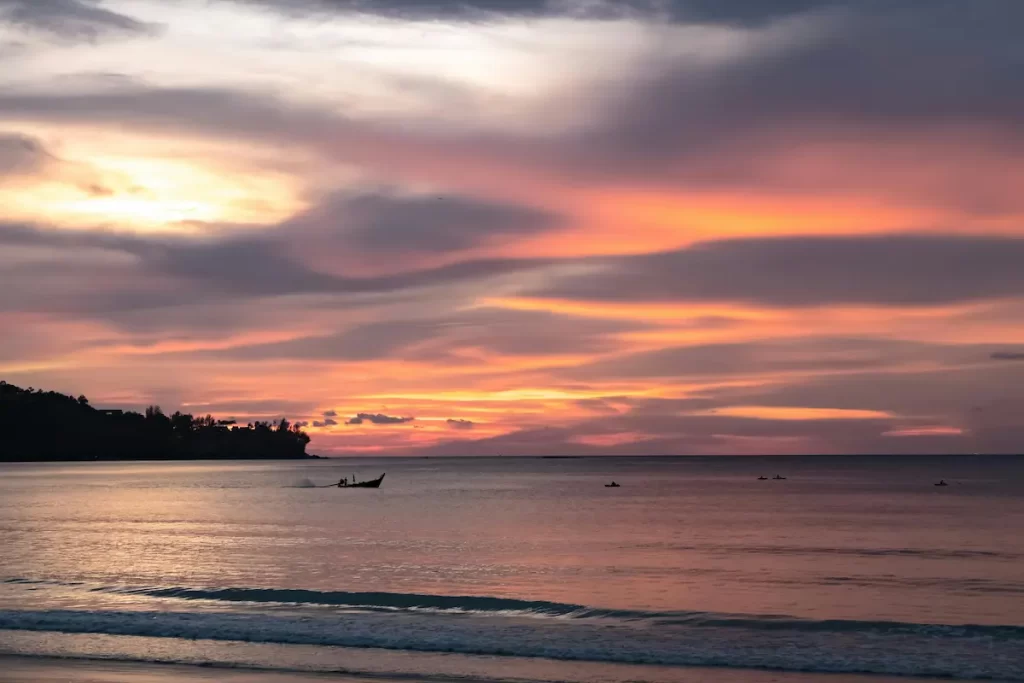
The sky attracted my attention immediately. It created mood, visual interest, and a sense of place. In many ways, it provided everything required for a successful atmospheric photograph. The colours were appealing, the cloud formations added texture, and the fading light created a calm and visually pleasing scene.
But what kept me returning to the image was not the sky.
It was the possibility of experience hidden beneath it.
The small boat introduced something atmosphere could not provide on its own. It introduced participation. It created a point of connection between the viewer and the environment. Instead of simply showing me what the evening looked like, it encouraged me to imagine what the evening might have felt like.
That distinction feels important.
Atmosphere in photography is often discussed as though it exists independently from the subjects within a frame. In reality, some of the strongest atmospheric photographs combine environmental mood with elements that allow viewers to place themselves inside the scene. The atmosphere creates the setting, but the experience creates the connection.
I think this is why certain photographs stay with us long after we have forgotten the technical details of how they were made.
We rarely remember a photograph because the white balance was perfect.
We rarely remember a photograph because the composition followed a particular rule.
More often, we remember photographs because they allowed us to feel something. They created a sense of presence, curiosity, nostalgia, calmness, wonder, or connection. They gave us a way to step beyond observation and become emotionally involved in the moment.
For me, that is where atmosphere in photography becomes most powerful.
Not when it simply creates mood.
Not when it simply creates beauty.
But when it helps transform a photograph from something we admire into something we can imagine experiencing for ourselves.
Looking at this image, I think that transformation begins the moment I stop looking at the sky and start imagining life beneath it.
Where This Image Works Best
One of the reasons I like including this section in Notes From the Frame is because photographs do not all need to perform the same role.
An image can be successful without becoming a portfolio photograph. It can communicate effectively without carrying a deep narrative. Sometimes a photograph’s greatest strength lies simply in its ability to create a particular feeling or represent a particular environment.
Looking at this image, I think its strongest quality is atmosphere.
The combination of colour, light, and calm water creates an immediate sense of time and place. Even before viewers begin analysing the details, they understand they are looking at the final moments of daylight fading across a coastal environment. That makes the photograph particularly effective in situations where mood and environmental character are important.
I could easily see this image working well within:
- travel editorials
- tourism publications
- coastal destination guides
- hotel and resort marketing
- slow travel content
- lifestyle-focused travel articles
In each of these situations, the photograph communicates atmosphere quickly and effectively. It creates an emotional impression without requiring extensive explanation.
I also think the image benefits from the presence of the boat.
While the atmosphere remains the dominant feature, the human activity on the water provides enough narrative potential to make the scene feel lived-in rather than purely scenic. The photograph feels less like a landscape and more like a moment taking place within a landscape.
Where I think the image becomes slightly less effective is in situations where a stronger story or deeper emotional connection is required.
The photograph hints at experience more than it fully communicates it. Viewers are invited to imagine what might be happening, but many of those details remain open to interpretation. That ambiguity can be a strength in editorial environments, but it may be less effective for documentary or highly narrative-driven work.
None of this is a criticism.
Different photographs solve different problems.
For me, this image succeeds most when it is allowed to do what it naturally does well: create atmosphere, encourage imagination, and provide a glimpse into a moment that feels calm, authentic, and quietly human.
Final Reflection
What I find most interesting about this photograph is that it changed the way I thought about it over time.
My first reaction was almost entirely focused on the sky.
The colours were appealing, the cloud textures created visual interest, and the fading light immediately established a strong sense of atmosphere. If somebody had asked me what I remembered most about the image, I would almost certainly have described the sky first.
Yet the longer I spent studying the photograph, the more my attention began shifting elsewhere.
The boat became more important.
The movement became more important.
The possibility of experience became more important.
What started as a photograph about atmosphere gradually became a photograph about connection.
That shift taught me something valuable about atmosphere in photography.
Atmosphere is often what attracts us to a photograph in the first place. It creates mood, establishes emotion, and encourages us to stop scrolling long enough to pay attention. But the photographs that stay with us often offer something beyond atmosphere alone.
They give us a way to participate.
Sometimes that participation comes through a person. Sometimes through movement. Sometimes through a small detail that allows us to imagine ourselves standing within the scene rather than simply observing it from a distance.
Looking back at this image, I do not think the most important element is the sunset.
Nor do I think it is the boat.
The most important element is the relationship between them.
The atmosphere creates the setting.
The boat creates the possibility of experience.
Together they create something more engaging than either element could achieve on its own.
For me, that is where atmosphere in photography becomes most powerful.
Not when it simply shows us a beautiful moment, but when it helps us imagine what it might have felt like to be there.
And sometimes that journey begins with a photograph that initially appears to be about the sky.
Continue Developing Your Photographic Eye
Many photographers spend years learning camera settings, editing techniques, and composition rules, yet still struggle to understand why some images feel more engaging than others.
If you would like personalised feedback on your own photographs, my mentoring sessions focus on observation, atmosphere, storytelling, composition, and the visual decisions that shape stronger images in the real world.
Explore the mentoring options available through Reflections Photography and continue developing the judgement behind the camera, not just the settings on it.
FAQ: Atmosphere in Photography
What is atmosphere in photography?
Atmosphere in photography refers to the mood, feeling, or emotional quality created by elements such as light, weather, colour, texture, and environmental conditions. Strong atmosphere helps viewers experience a scene beyond its physical appearance.
Why is atmosphere in photography important?
Atmosphere in photography often creates the first emotional response to an image. Before viewers analyse subjects, composition, or storytelling, they frequently react to mood, light, and environmental conditions.
Does atmosphere in photography always require dramatic weather?
Not at all.
While storms, fog, rain, and dramatic sunsets can create atmosphere, many atmospheric photographs rely on subtle conditions. Soft light, calm water, gentle colour transitions, and quiet moments can often create just as much atmosphere as more dramatic scenes.
What is the difference between atmosphere and storytelling in photography?
Atmosphere creates mood.
Storytelling creates meaning.
A photograph can have strong atmosphere without telling much of a story, while a strong storytelling image may rely very little on atmosphere. The most engaging photographs often combine both elements.
Why do some atmospheric photographs feel more immersive than others?
Atmosphere attracts attention, but immersion often comes from connection. Small details such as people, movement, human activity, or visual relationships can help viewers imagine themselves inside a scene rather than simply observing it.
Can atmosphere in photography exist without people?
Absolutely.
Weather, light, colour, architecture, landscapes, reflections, and environmental details can all create atmosphere. People are not required, although human elements often help strengthen emotional connection and viewer engagement.
How can photographers create stronger atmosphere in photography?
Photographers can strengthen atmosphere by paying attention to:
- quality of light
- weather conditions
- colour relationships
- environmental textures
- timing
- mood
- visual simplicity
Atmosphere often emerges from observation rather than technical complexity.
What makes atmosphere in photography become an experience?
For many viewers, atmosphere becomes experience when the photograph provides a way to imagine being there. A small human element, movement within the scene, or a relatable moment can transform a photograph from something we admire into something we feel connected to.
About the Author
David Hibbins is a travel and observational photographer focused on atmosphere, environmental storytelling, and real-world visual experiences across Thailand and Asia.
Through Reflections Photography and the Notes From the Frame series, his work explores how judgement, observation, and visual decision-making influence stronger photography more than technical perfection alone.
His photography philosophy centres around:
- observation over assumption
- meaning over spectacle
- atmosphere over distraction
- visual judgement over gear obsession
- storytelling over simple description
Rather than focusing heavily on camera settings or equipment, his work examines how photographers can develop a deeper understanding of composition, atmosphere, narrative, and the visual relationships that shape more meaningful images.