Why This Travel Photography Composition Feels Organised Instead of Chaotic
Notes From the Frame is a series exploring the strengths, tradeoffs, atmosphere, storytelling, and visual decisions that shape real-world photography.
At first glance, this image feels busy.
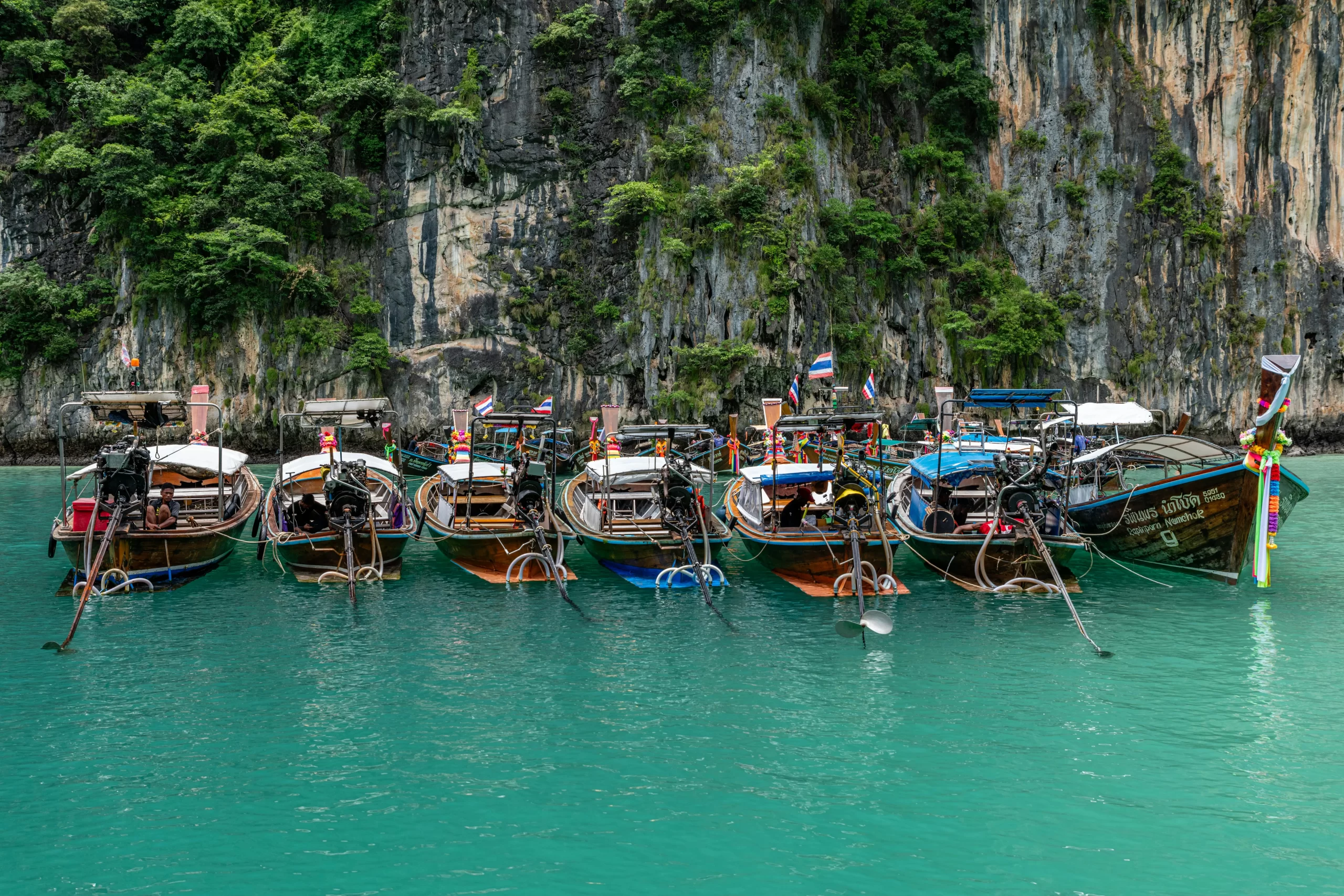
Longtail boats overlap across the frame while ropes, engines, flags, reflections, and dense limestone cliffs all compete for space at the same time. On paper, this kind of scene should feel visually overwhelming. There are very few clean areas for the eye to rest, and there is no single dominant subject immediately controlling the frame.
Yet the image still feels organised.
One reason this travel photography composition works is that the repetition creates structure inside the complexity. The boats may all be slightly different in colour, shape, and spacing, but they still belong to the same visual system. That consistency allows the viewer to move through the frame naturally rather than feeling trapped inside visual clutter.
The image also benefits from scale relationships. The cliffs dominate the upper portion of the frame with heavy texture and environmental weight, while the water below creates a calmer foreground that gives the composition room to breathe. Instead of isolating a single subject, the frame works by balancing relationships between multiple elements at once.
This is something that often appears in observational and documentary-style travel photography. Not every successful image depends on dramatic action or a perfectly isolated focal point. Sometimes the strength of a frame comes from how the environment settles into visual order naturally.
In this breakdown, we’ll look at what helps the image work, where the composition could be stronger, and why scenes like this are useful reminders that strong travel photography composition is often more about organisation and visual relationships than simplicity alone.
What Works in the Frame
Repetition and Rhythm
The strongest element in this image is repetition.
Nearly every major component in the frame repeats in some form. The longtail boats share similar hull shapes, similar proportions, similar directional flow, and even similar mechanical structures through the exposed engine shafts extending into the water behind them. Individually, none of these boats are especially dominant, but together they create visual rhythm across the scene.
That rhythm is what stops the image from collapsing into chaos.
Strong travel photography composition often depends on giving the viewer a way to move naturally through a frame. Here, the repetition acts almost like a visual guide system. Your eye moves from one boat to another without feeling abruptly interrupted because the forms feel related to each other, even when the colours and details vary slightly.
The spacing also matters. The boats overlap enough to create density and atmosphere, but not so heavily that they merge into an unreadable mass. There is still enough separation for the viewer to recognise individual shapes and layers within the frame.
This is an important distinction in observational photography. Complexity alone does not automatically create interest. In many cases, complexity without organisation simply creates visual noise. What helps this image succeed is that the repetition introduces order inside an already busy environment.
Environmental Balance
Another reason the frame works is the relationship between the boats and the cliffs behind them.
If the image only contained boats floating on open water, the scene would likely feel much lighter and less grounded. The limestone cliffs add visual weight and environmental context that help stabilise the composition. Their darker texture occupies the upper portion of the frame and creates a sense of scale that makes the boats feel small within the landscape rather than isolated objects floating independently.
This balance between human activity and environmental scale gives the image more depth than a straightforward tourism photograph.
The cliffs are also visually dense, which could easily become overpowering in weaker compositions. However, because the lower section of the image contains calmer water tones and more spacing between objects, the frame maintains enough separation to remain readable.
One of the more interesting aspects of this travel photography composition is that the environment itself becomes part of the structure. The cliffs are not simply a backdrop. They actively control the emotional and visual weight of the frame.
Use of Foreground Space
The foreground water is doing more compositional work than it might initially appear.
Without the open water at the bottom of the frame, the image would feel compressed very quickly. The scene already contains heavy texture, overlapping boats, ropes, reflections, and dense rock formations. The softer water foreground introduces breathing room that helps the eye settle before moving deeper into the image.
This type of spacing is often important in travel photography composition, especially when working in visually crowded environments. Not every part of the frame needs equal detail or equal intensity. In many successful images, calmer areas help support more detailed sections elsewhere.
The water also contributes subtle colour separation. The turquoise and green tones create contrast against the darker boats and limestone cliffs without feeling artificial or oversaturated. That colour contrast quietly helps define the layers within the scene.
Layering and Depth
The image benefits from clear environmental layering.
The foreground begins with open water and reflections, the midground contains the boats themselves, and the background is dominated by the cliffs and vegetation. These layers help create spatial depth while keeping the frame readable despite the amount of detail present.
This is one reason the image still feels controlled even though there is no single dominant focal point.
Instead of relying on one subject, the composition encourages the viewer to gradually move deeper through the scene. The eye transitions naturally from water, to boats, to cliffs, creating a more observational viewing experience rather than an immediate emotional punch.
That slower visual progression fits well within documentary-style travel photography because it encourages exploration rather than instant impact.
What Story Does This Image Tell?
This image tells a quieter story than many travel photographs attempt to tell.
There is no dramatic human interaction, no obvious emotional subject, and no singular moment of tension dominating the frame. Instead, the storytelling comes from the relationship between the environment and the organised activity taking place within it.
The longtail boats immediately suggest movement, tourism, transport, and routine. Even while sitting still in the water, they imply that this location is constantly in motion. People arrive here, leave here, work here, guide tours here, and pass through here every day. The boats feel less like isolated subjects and more like part of a functioning coastal system.
At the same time, the limestone cliffs create a completely different sense of scale and permanence. The boats feel temporary and active, while the cliffs feel ancient and immovable. That contrast gives the image more narrative depth than a simple “boats in Thailand” photograph.
What makes the storytelling effective is that the frame does not try too hard to force emotion. The image remains observational. It allows the viewer to recognise atmosphere and context naturally rather than aggressively directing them toward a specific emotional reaction.
This is something that often appears in documentary-style travel photography and observational photography more broadly. Not every image needs a dramatic story to remain visually interesting. Some photographs work because they communicate environment, rhythm, routine, or the relationship between people and place.
In this case, the story is less about an individual moment and more about a location settling into its daily rhythm before the movement begins again.
At the same time, it is important not to overstate the narrative strength of the frame. This is not a deeply emotional storytelling image, nor is it heavily character-driven. The image succeeds more through atmosphere, organisation, and environmental context than through human narrative. That distinction matters, because not every successful travel photography composition needs to carry the same emotional weight to remain effective.
What Could Be Stronger
Right-Side Visual Weight
One of the few areas where the composition becomes slightly uneven is on the right-hand side of the frame.
The larger boat positioned near the edge carries more visual weight than the surrounding elements because of its stronger side profile, brighter decoration, and more dominant diagonal angle. As a result, the eye tends to drift repeatedly toward that section of the image before fully exploring the rest of the frame.
This does not break the composition, but it slightly interrupts the otherwise balanced rhythm created by the repeated boat structures across the water.
A very subtle crop from the right side could potentially reduce some of that pull, although there is a tradeoff involved. Cropping too aggressively would begin to compress the spacing between boats and weaken some of the environmental breathing room that currently helps the image feel open.
That balance between control and overcorrection is important in travel photography composition. Sometimes a frame benefits more from preserving atmosphere than from chasing perfect visual symmetry.
Flat Lighting Conditions
The lighting is practical and believable, but it is not especially dramatic.
There are no strong directional shadows, no heavy weather atmosphere, and no particularly emotional light shaping the scene. Because of that, the image relies heavily on organisation, layering, and visual structure rather than mood-driven lighting to hold attention.
That is not necessarily a weakness on its own. In fact, many successful examples of documentary-style travel photography work perfectly well under flatter natural light because realism becomes part of the visual identity. However, it does mean the frame depends more on composition than atmosphere to remain engaging.
If this exact scene had been photographed during softer early morning light, approaching weather, or lower golden-hour contrast, the emotional depth of the image may have increased significantly. The cliffs would likely separate more strongly from the sky and the boats may have gained additional texture and dimensionality.
At the same time, stronger light may also have introduced harsher reflections and more visual distraction across the water, so the tradeoff is not entirely one-sided.
Limited Human Presence
Although the image suggests tourism and movement, there is very little direct human presence visible within the frame itself.
This creates an interesting tension. The viewer understands that the boats exist because of people, but the absence of clearly visible human interaction means the image feels more environmental than personal.
For some viewers, this strengthens the observational quality of the frame because the attention remains on atmosphere and structure. For others, the image may feel slightly emotionally distant compared to travel photographs that contain a clearer human anchor.
Neither approach is automatically better, but it changes how the image communicates. This frame succeeds more through environmental storytelling and travel photography composition than through emotional connection to an individual subject.
The Bigger Photography Lesson
One of the more interesting aspects of this image is that it challenges a common idea often repeated in photography education — the belief that every strong photograph needs a single dominant subject.
In reality, many successful examples of observational and documentary-style travel photography work very differently.
Rather than isolating one person, object, or dramatic moment, they rely on relationships between elements inside the frame. The strength comes from how shapes, spacing, atmosphere, texture, colour, and environmental context interact with each other as a system.
This image is a good example of that approach.
The boats matter, but the image is not really about one specific boat. The cliffs matter, but the image is not purely landscape photography either. Even the water itself plays an important role by creating breathing room and helping separate the visual layers within the frame.
What ultimately holds the composition together is organisation.
That is an important concept in travel photography composition because real-world environments are rarely clean or simplified. Streets become crowded, markets become visually noisy, coastlines become busy with tourism infrastructure, and documentary scenes often contain competing elements that cannot simply be removed from the frame.
The challenge is not always:
“How do I simplify this scene?”
Sometimes the better question is:
“How do I organise this complexity so the viewer can still move through the frame naturally?”
That distinction changes the way photographers approach observation.
Many beginner photographers spend large amounts of time searching for isolated subjects because isolated subjects are easier to control visually. But as photographers become more comfortable working in real environments, the ability to recognise visual relationships often becomes more valuable than the ability to isolate a single object perfectly.
This is especially true in travel and street photography where atmosphere frequently depends on multiple elements interacting together at once.
The image also highlights another useful lesson: not every successful photograph needs intense emotion or dramatic action. Some frames succeed because they communicate rhythm, environment, routine, scale, or atmosphere in a believable way.
In this case, the photograph works less as a dramatic storytelling image and more as an observational study of organised activity within a larger natural environment. That quieter approach may not create instant emotional impact, but it often creates stronger long-term viewing depth because the eye continues exploring the frame over time.
That is one reason strong travel photography composition often depends more on visual relationships and environmental awareness than on spectacle alone.
Possible Uses for This Image
One of the more practical questions photographers should ask after analysing an image is:
“Where does this frame actually belong?”
A photograph can be visually successful while still being limited in how it functions commercially, editorially, or emotionally. Understanding that distinction is an important part of developing stronger photographic judgement.
This image works particularly well in editorial and tourism-related environments because the composition communicates place clearly without feeling overly staged. The boats, water, and limestone cliffs immediately establish a recognisable coastal Southeast Asian environment while still retaining an observational feel.
Because of that, this travel photography composition would work strongly in:
- travel articles
- tourism websites
- destination guides
- editorial travel publishing
- brochure support imagery
- hotel or tour marketing
- visual atmosphere sections within longer travel features
The frame also works well as a supporting image rather than a singular hero image. It provides environmental context and visual rhythm, making it useful for layouts where atmosphere and place identity matter more than direct emotional storytelling.
In portfolio use, the image fits comfortably within observational travel photography or documentary-style travel photography collections because it demonstrates environmental awareness, layered composition, and visual organisation rather than relying purely on dramatic light or spectacle.
At the same time, the image would likely be less effective in campaigns requiring strong emotional connection or immediate human engagement. Because there is minimal visible human interaction, the frame feels more environmental than personal. That makes it weaker for:
- emotional advertising campaigns
- character-driven storytelling
- portrait-led branding
- highly minimalist design layouts
This is not a limitation so much as a reminder that different photographs solve different visual problems.
Part of strong travel photography composition is understanding not only whether an image works, but also where it works best.
Final Reflection
What makes this image successful is not dramatic light, perfect subject isolation, or a highly emotional moment.
Instead, the strength of the frame comes from organisation.
The scene contains a large amount of visual information — overlapping boats, mechanical details, textured cliffs, reflections, colour variation, and environmental density — yet the composition still feels readable because the relationships between those elements remain controlled. Repetition, spacing, layering, and environmental balance quietly hold the image together.
The photograph also works because it stays observational. It does not try to force emotion or manufacture drama that is not naturally present in the scene. The frame is comfortable allowing atmosphere, structure, and context to carry the viewing experience instead.
That restraint is important.
In many forms of travel and street photography, stronger images often emerge not from simplifying the environment completely, but from recognising how complexity can still feel organised when the relationships inside the frame are working together.
This image is a good reminder that successful travel photography composition is not always about finding a single perfect subject. Sometimes it is about understanding how an entire environment settles into visual rhythm naturally.
Continue Developing Your Visual Eye
Learning photography is often presented as a technical process — camera settings, gear reviews, editing tricks, and software workflows.
But many of the decisions that shape stronger images happen before the shutter is ever pressed.
Observation, timing, visual balance, atmosphere, subject relationships, and understanding why a frame works all play a major role in developing stronger photography over time.
If you enjoy this style of analysis, I also offer photography coaching focused on visual judgement, composition, observational photography, and real-world image evaluation across travel, street, and macro photography.
The goal is not simply to create technically correct images, but to develop a stronger understanding of how photographs communicate, organise attention, and tell stories naturally.
You can learn more about photography mentoring here.
FAQ Section
What makes a strong travel photography composition?
Strong travel photography composition is often less about perfect simplicity and more about visual organisation. Repetition, spacing, layering, atmosphere, and subject relationships all help guide the viewer naturally through a frame.
Does every travel photograph need to tell a story?
Not always. Some images are heavily narrative-driven while others succeed more through atmosphere, structure, or environmental observation. The important thing is understanding what the image communicates rather than forcing emotional storytelling into every frame.
What is observational photography?
Observational photography focuses on recognising and documenting real environments, relationships, atmosphere, and moments as they naturally exist rather than heavily directing or staging scenes.
Why does this image feel organised instead of chaotic?
The repeated boat shapes, environmental layering, foreground spacing, and consistent visual rhythm help create structure within a visually busy environment. Those relationships allow the eye to move through the frame more comfortably.
Where would this type of travel image work best?
This type of image works especially well in editorial travel publishing, destination guides, tourism websites, documentary-style portfolios, and atmosphere-driven travel content where environmental context is important.
Related Reading
If you are interested in exploring further articles from the Notes in The Frame series please continue here.
About the Author
David Hibbins is a Thailand-based photographer, writer, and publisher focused on travel, street, macro, and observational photography.
His work explores atmosphere, visual relationships, environmental storytelling, and the quieter details that often shape how places feel rather than simply how they look. Through Notes From the Frame, he analyses the strengths, tradeoffs, and visual decisions behind real-world photography with a focus on judgement, composition, and storytelling rather than camera settings alone.
Drawing from more than 15 years of experience in business coaching and advisory roles, David’s approach to photography education is heavily influenced by observation, decision-making, communication, and long-term creative development. That analytical background now shapes much of his photography coaching and image critique work.
Today, his work combines photography, publishing, and coaching across travel, street, and macro photography with a strong emphasis on observational awareness and visual storytelling.