
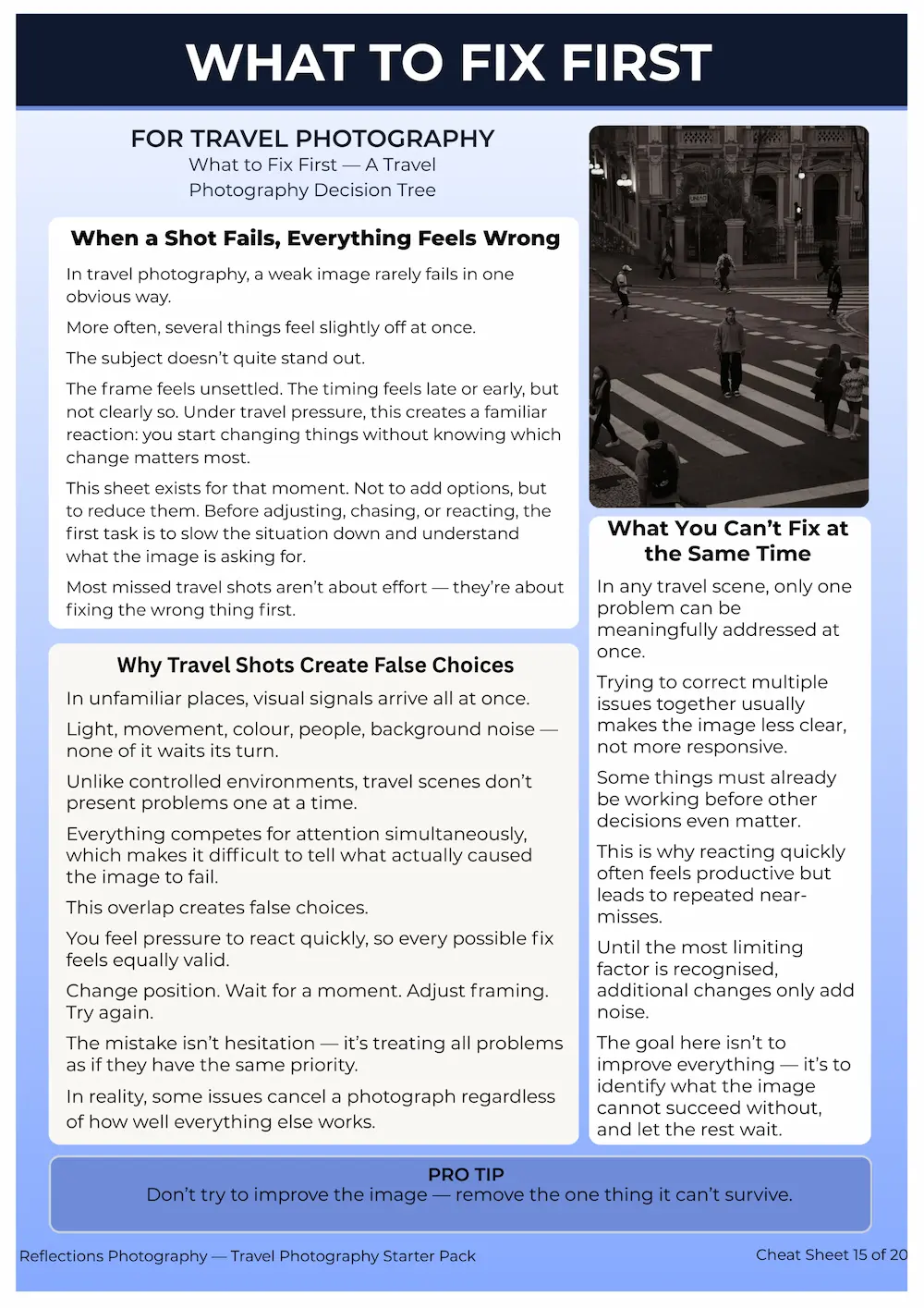
What to Fix First — A Travel Photography Decision Tree
$7.00
What to Fix First — A Travel Photography Decision Tree helps you quickly diagnose why a travel photo isn’t working and decide what to adjust first. This cheat sheet provides a simple decision process for identifying problems with exposure, sharpness, light, or composition so you can correct them quickly.
Designed for travellers working in fast-changing environments, it helps you make clear adjustments instead of guessing which camera setting to change.
Includes: Printable A4 PDF + phone-friendly version.
Description
What to Fix First — A Travel Photography Decision Tree provides a practical way to troubleshoot travel photos when something in the image does not look right. When photographing unfamiliar scenes, it can be difficult to know whether the issue comes from camera settings, lighting, motion, or composition.
This cheat sheet helps you diagnose the problem quickly and decide what to adjust first.
What you’ll get (digital download):
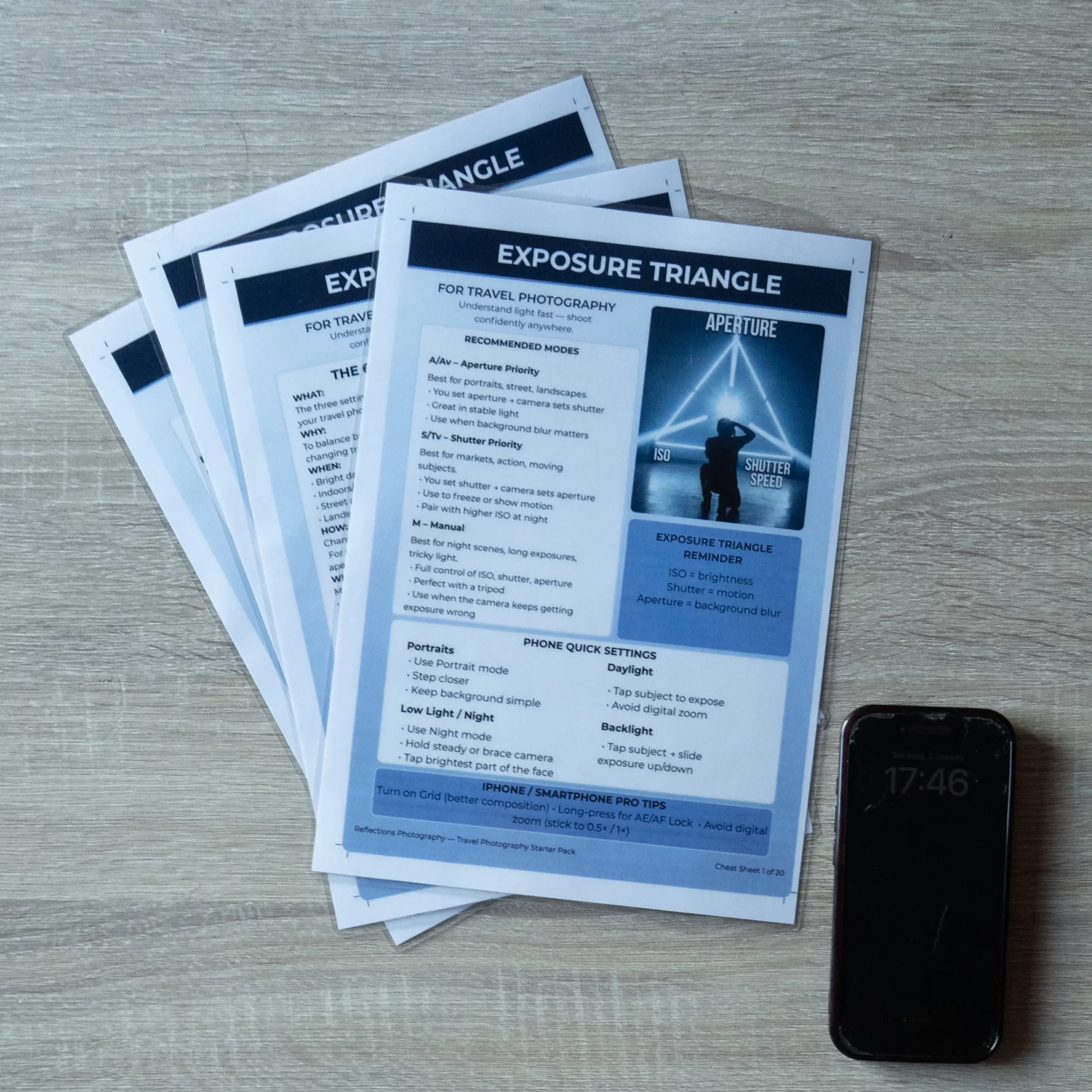
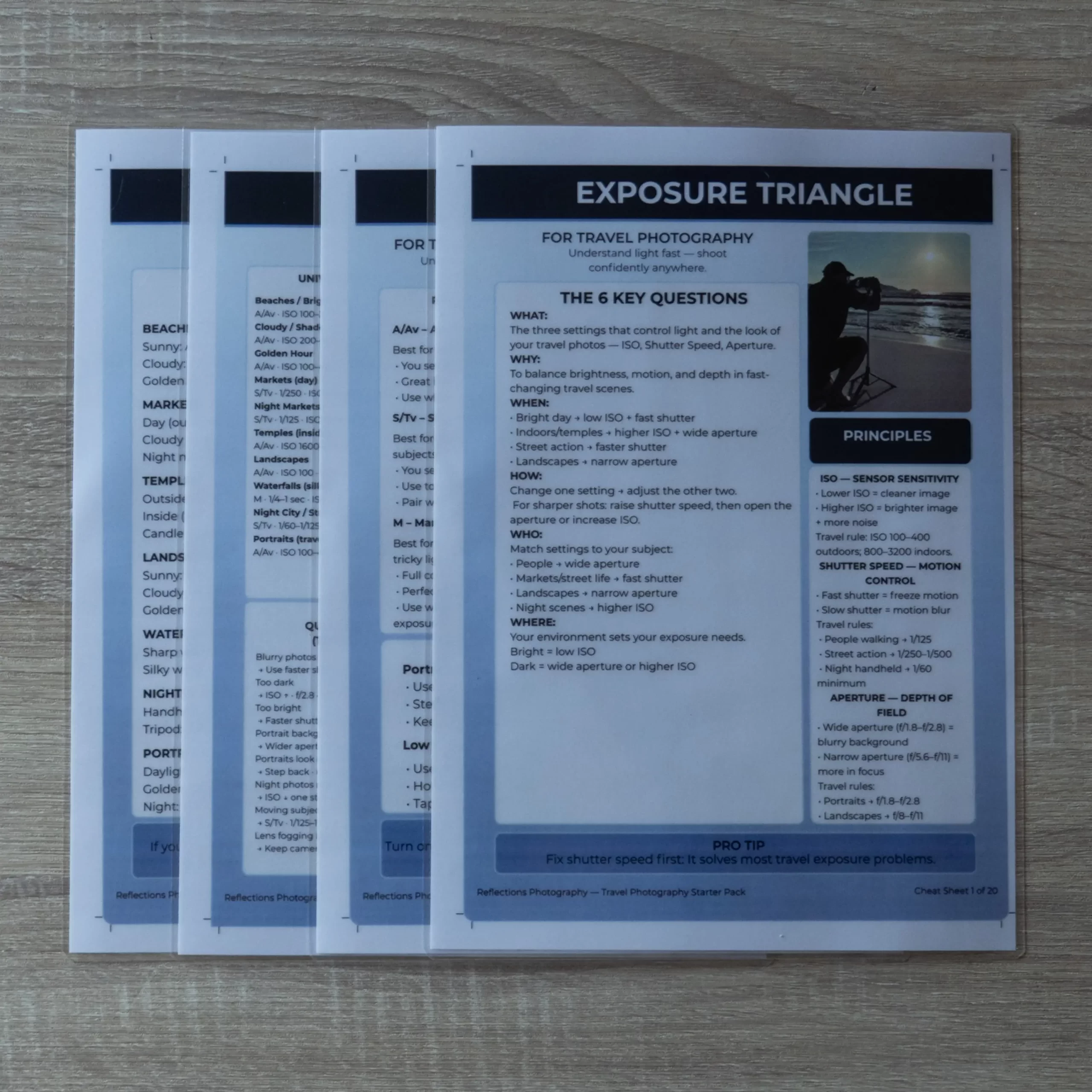
Printable PDF (A4) + phone-friendly version
A simple decision tree for diagnosing photography problems
Clear guidance for identifying common travel photo issues
Practical steps for correcting exposure, blur, and composition
Quick decisions when time and light are changing
Who it’s for:
Travellers learning how to adjust camera settings
Photographers unsure what to change when a photo fails
Anyone wanting a clear troubleshooting process while shooting
Travel photography often happens quickly and in unpredictable conditions. You might photograph a scene only to realise afterward that something feels wrong. The image may be too dark, too bright, slightly blurred, or visually confusing.
Without a clear process, photographers often change several settings at once and still struggle to improve the result.
This cheat sheet introduces a simple decision tree that helps you diagnose problems step by step.
The first step is identifying the most obvious issue. Is the image soft because of motion or camera shake? Is the exposure incorrect because the scene is too bright or too dark? Or is the subject lost in the frame because the composition lacks clarity?
Once the main issue is identified, the guide shows which adjustment should come first.
For example, if the image is blurred due to motion, the priority may be increasing shutter speed. If the scene is too dark, adjusting ISO or aperture may help maintain the necessary shutter speed. If the photograph feels visually confusing, a small change in position or framing can often simplify the composition.
The decision tree structure allows you to move through these questions quickly.
Instead of guessing which setting to change, you follow a simple sequence of observations that leads to a practical solution. This approach reduces hesitation and helps you learn how different settings affect the final image.
For beginners, the guide provides a clear troubleshooting method that removes much of the uncertainty around camera settings. For more experienced photographers, it acts as a quick reminder that many problems can be solved by addressing the most important issue first rather than adjusting everything at once.
Travel photography often requires quick decisions and simple solutions. What to Fix First — A Travel Photography Decision Tree gives you a structured way to diagnose problems and correct them efficiently while shooting.
Reviews
There are no reviews yet.