Wat Suwan Khiri Wong, Patong – 2026 guide
Some places don’t ask to be photographed.
They ask you to slow down long enough to notice why.
Patong never eased me in. It always arrived all at once — noise first, then heat, then motion stacked on motion. Scooters straining uphill, vans rattling downhill, engines competing for attention as if volume alone could tame the afternoon.
And then there was the gate.
Red pillars. Gold trim. Stillness that didn’t announce itself.
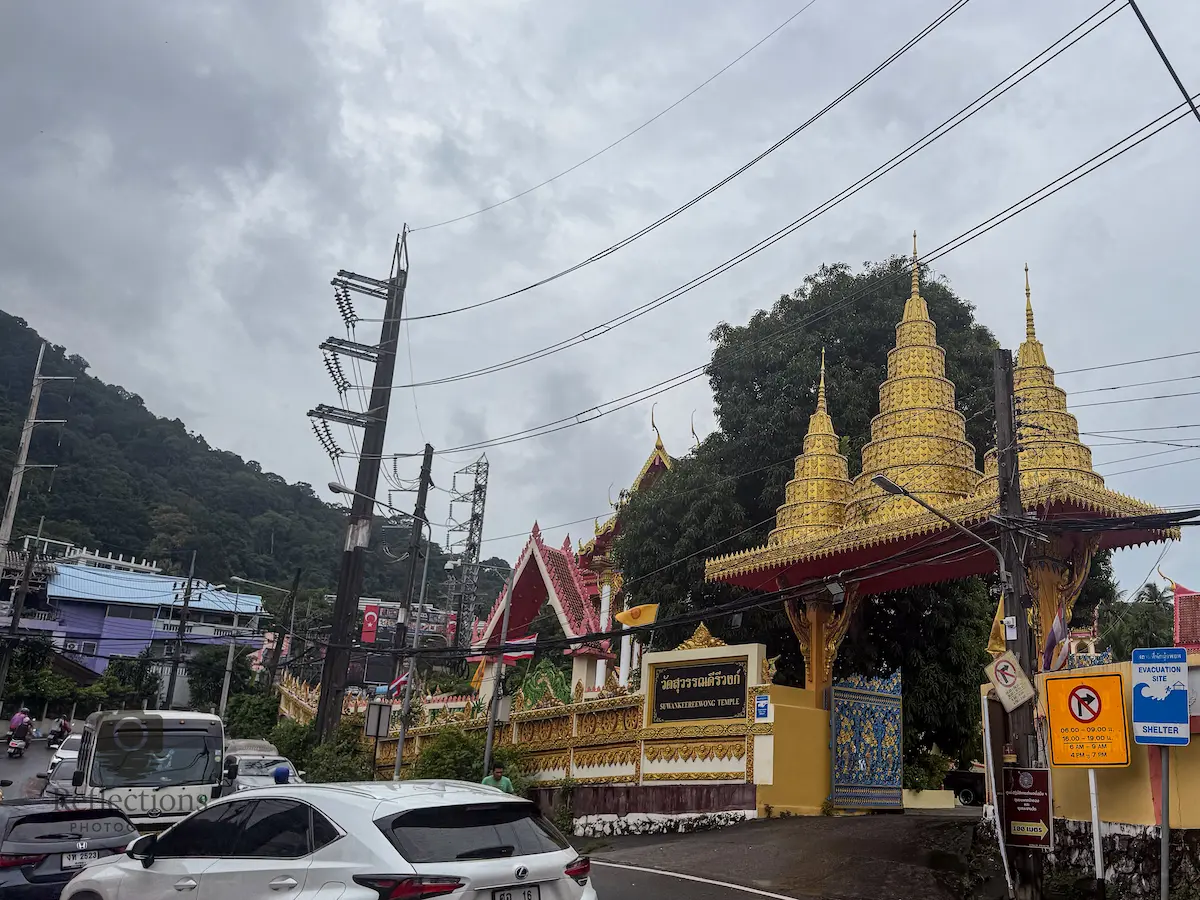
Wat Suwan Khiri Wong sits at the base of Patong Hill, exactly where the island seems to decide what kind of place Patong is going to be. Locals still call it Wat Patong — Patong Temple — a name that feels more lived-in than official. It isn’t hidden. It’s simply passed by, again and again, by people already thinking about the beach, the bar, the next promise waiting further down the road.
The first time I stepped through the gate, the sound didn’t disappear — it softened. Like someone turning the world down a few notches rather than switching it off completely. A stray dog slept half in shade, half in sun. A woman crossed the courtyard with lotus flowers in a thin plastic bag, moving with the ease of habit. Somewhere above, sparrows argued over something too small to matter.
I didn’t lift the camera straight away. I learned early on that places like this punish impatience.
The tiles held heat from the day. The air carried incense, candle wax, old stone — not fresh smells, but layered ones. A monk crossed the courtyard adjusting his robe, moving with the unhurried confidence of someone who had made peace with the temperature decades ago. Outside the gate, Patong kept colliding with itself. Inside, time stretched just enough to breathe.
Wat Suwan Khiri Wong Patong is old — older than Patong as most people imagine it. Monks were already chanting here in the late 18th century, when the valley was forest and footpaths rather than neon and signage. The temple was once known as Wat Pa Tong, the Temple of the Banana-Leaf Forest. The name changed gradually after the temple received its formal boundary in 1792, but locals never fully let go of the original. History here isn’t announced. It lingers.
You feel it in the slightly uneven tiles, in paint layered over paint, in murals that have endured more sun than restoration. The past hasn’t been preserved behind glass. It’s been used.
The Ubosot and the Problem of Distance
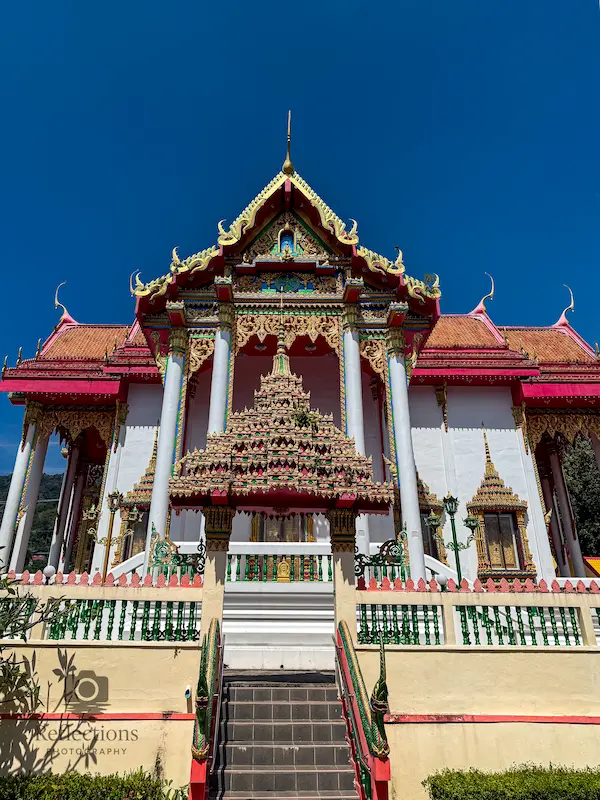
From a photographer’s perspective, the ubosot is the anchor of the entire compound — and also its most difficult subject.
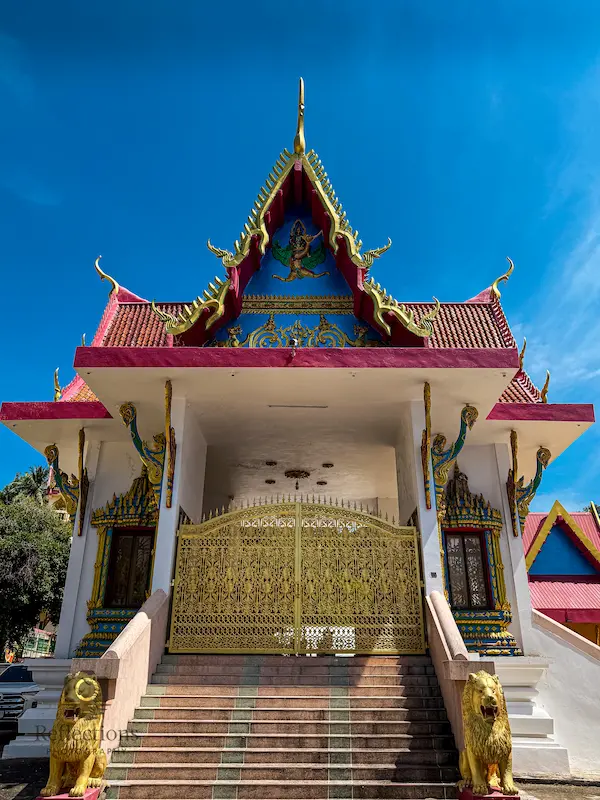
It rises higher than you expect, elevated above the courtyard by a couple of metres, elegant and confident without trying. The proportions are right. The symmetry is strong. The gold trim catches light in a way that changes character by the hour. This is the building your eye returns to again and again at Wat Suwan Khiri Wong.
And yet, it resists easy photographs.
The courtyard fencing limits working distance. The ornate gate roof — beautiful in its own right — interrupts a clean end-on view. Stand too close and the scale overwhelms the frame. Step back too far and you lose separation, context bleeding in from every side. Vertical compositions struggle because of the elevation; horizontal ones require patience and compromise.
I’ve learned not to fight that resistance.
Late afternoon is when the ubosot forgives. The light softens, shadows stretch, and the gold shifts from sharp yellow to something warmer, almost amber. Midday tells the truth without mercy — glare, heat haze, reflections bouncing off tiles like sarcasm. I’ve tried to win that battle. The sun always wins.
Some of the most honest images came when I stopped chasing the perfect hero shot and accepted the constraints. Side-on perspectives began to matter. Context became part of the composition rather than something to crop out. The building didn’t want to be isolated. It wanted to be understood.
Walking the Grounds, Finding Angles
Just inside the main gate, to the right, sits a viharn that often gets overlooked in favour of the larger structures beyond. It’s a good place to pause, both visually and physically. From here, you can begin to see how the temple reveals itself sideways rather than head-on.
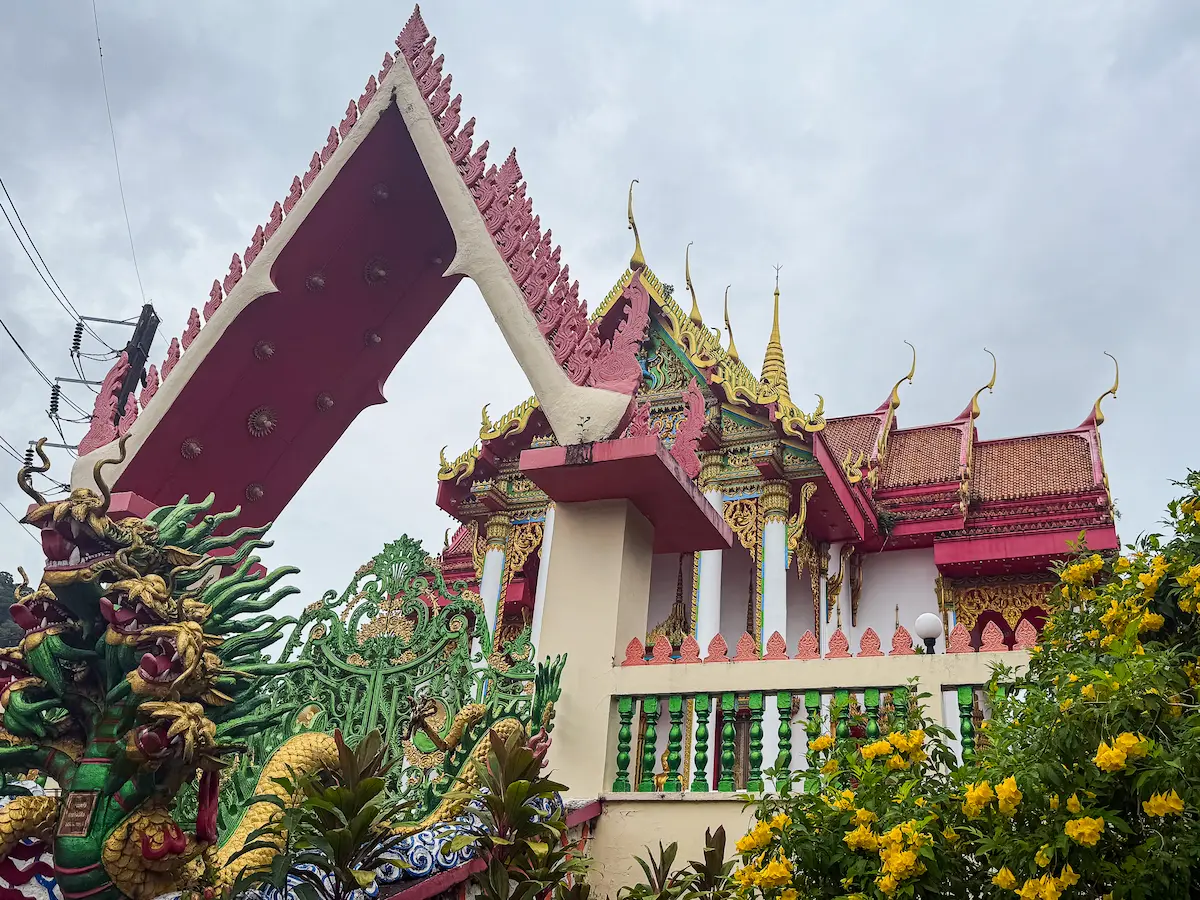
Moving along the side of the ubosot, the character changes. Yellow trumpet flowers grow near the roadside end, offering a natural frame that softens the architecture and pulls the eye inward. The flowers don’t dominate — they suggest. Used carefully, they give scale and warmth without stealing attention from the building itself.
From this angle, the ubosot feels taller, more grounded. The elevation that complicates frontal shots becomes an advantage, lending weight and authority without demanding perfection.
Following the road as it curves around the compound leads past secondary buildings — spaces used for teaching, for shared meals, for the everyday mechanics of temple life. These areas rarely appear in photographs, yet they’re where the temple feels most alive. Mats stacked against walls. Plastic chairs waiting for festivals. Traces of conversation lingering in the air.
A right turn brings you toward a secondary gate. A left leads back toward the main entrance road — short, quiet, almost unassuming. From here, the bell tower comes into view.
The bell tower is easy to miss if you’re moving too quickly. Stand in the courtyard of the ubosot and you can frame the ornate gate roof and the bell tower together, the lines echoing each other in a way that feels deliberate rather than decorative. From the gate itself, looking inward, the bell tower takes on a more dramatic role — framed by the first balcony above, rising with quiet authority.
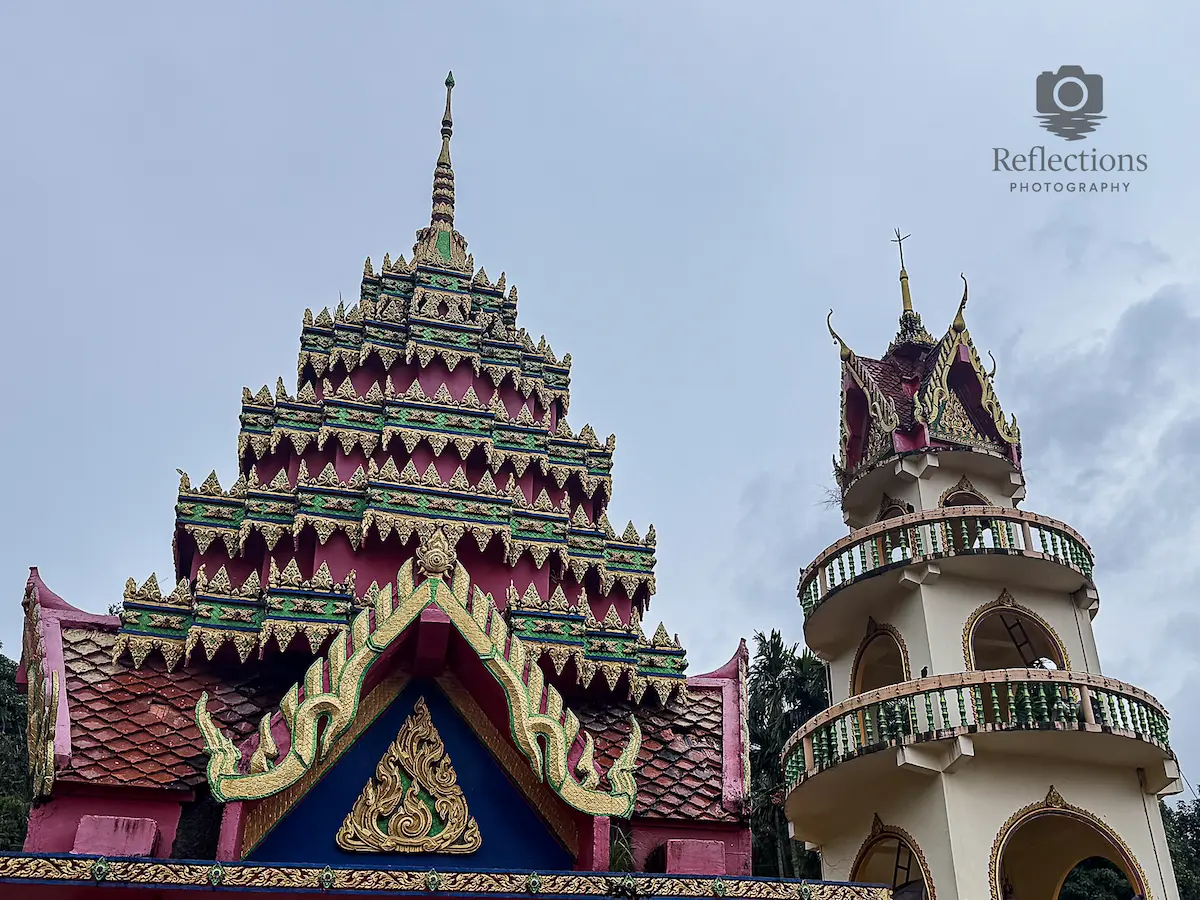
At the base of the tower, tucked beneath it, is a small shrine. A Buddha image. A stone ledge where coins are placed carefully along the edge. Incense burns slowly, smoke curling upward in thin lines that catch the light just long enough to notice. It’s an easy place to linger. An easy place to over-shoot. I learned to take one frame and step back.
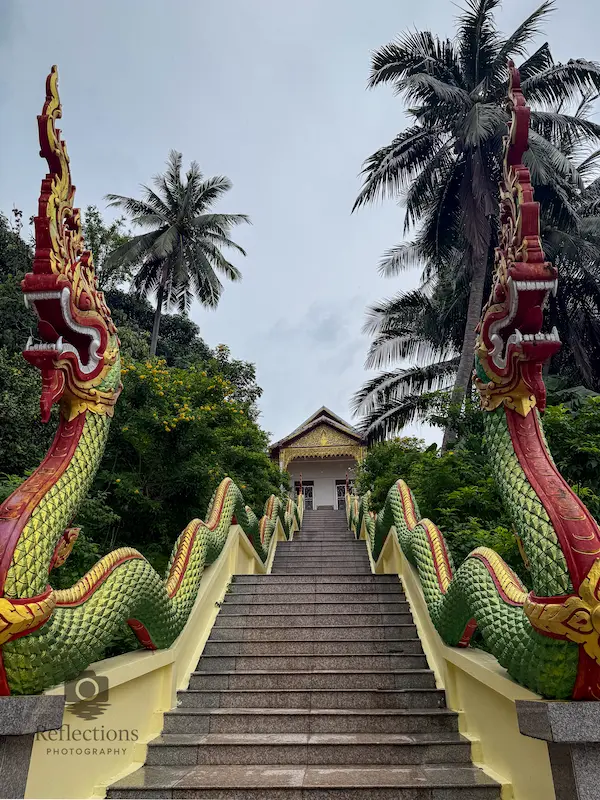
The naga-lined staircase rises nearby, guarded but not announced. From below, you see only part of the roofline above. The rest is implied. Climbing the stairs reveals the building gradually, the naga bodies forming natural leading lines that guide the eye upward.
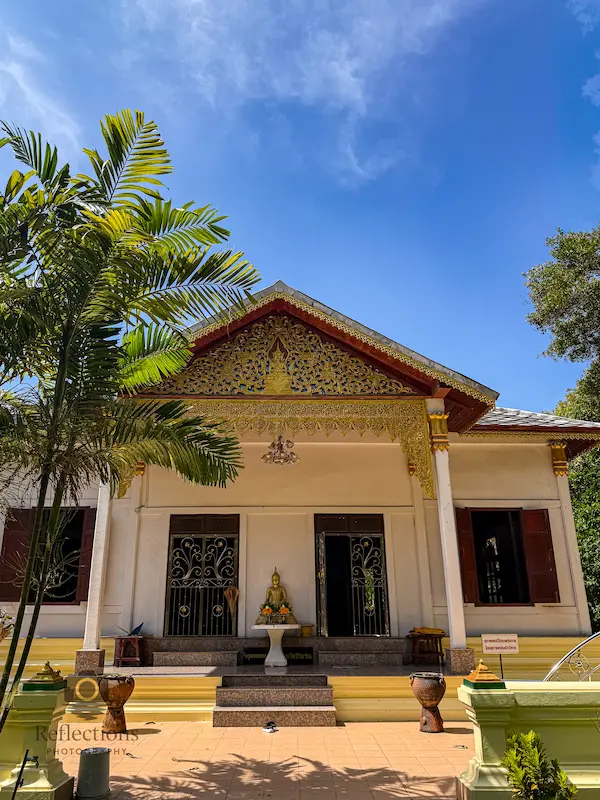
At the top sits an older structure — often referred to as a viharn, though its exact history isn’t loudly declared. It carries the feel of an older ubosot in its proportions, but without sema stones. Inside, murals line the walls, softened by time. Guardians stand at the entrance, worn but expressive. The altar holds multiple Buddha images, layered rather than singular.
This building doesn’t ask for grand images. It rewards patience.
Behind it, the ground roughens into grass and small patches of wild growth. On quieter days, there are opportunities for close-up work — flowers, insects, small details easily missed when chasing architecture. Through the trees, Patong appears in fragments rather than panoramas. A building edge. A road line. Movement filtered through leaves and fencing. These aren’t landscape views. They’re context — reminders of where you are without overwhelming the moment.
Learning When Not to Shoot
I’ve stood here when the doors of the main hall were open and ceremonies were not. Light entered in narrow slices, catching the polished floor, the folds of the Buddha image, the edges of offerings left quietly to one side. A monk was reading beneath a fan that did almost nothing. Someone knelt in prayer without sound.
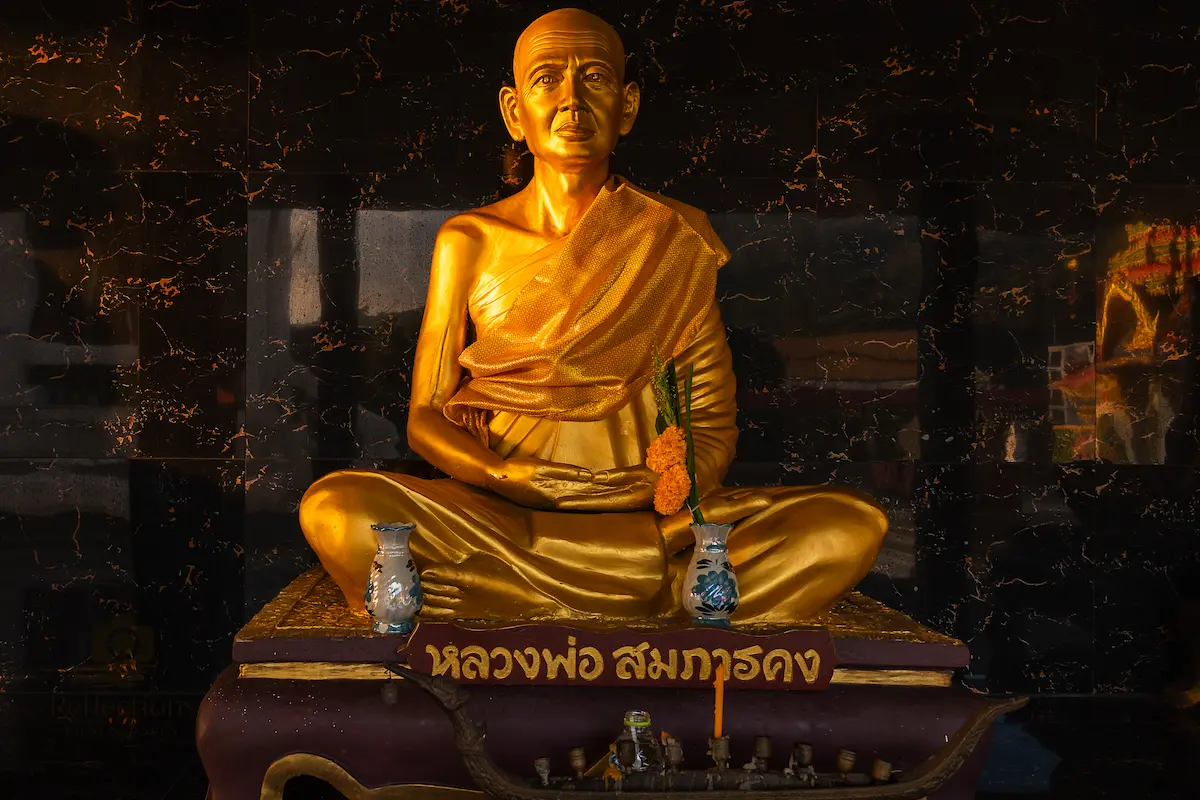
I stayed near the doorway. Close enough to feel the weight of the room. Far enough not to intrude.
That boundary matters more than settings ever will.
Some afternoons, after walking the grounds, watching the light move, adjusting nothing but my position, I left without taking a single frame. Not because there was nothing to photograph — but because the place wasn’t asking for it.
Wat Suwan Khiri Wong Patong teaches restraint without instruction. It doesn’t reward speed. It doesn’t perform. It holds still while Patong rushes past, and in doing so, it reveals what patience looks like.
Foreigners take photographs here. Locals take breaths.
That difference stays with you.
Seeing Patong Differently
Standing at the gate later, camera lowered, I understood why this temple changes the way Patong feels. The chaos outside stops sounding like noise and starts sounding like rhythm. Markets make more sense. Side streets reveal themselves. Shrines between massage shops feel intentional rather than decorative.
Patong isn’t shallow. It’s layered.
Wat Suwan Khiri Wong doesn’t explain the town — it contextualises it. It reminds you that even in the busiest corners of Phuket, there are places that refuse to rush.
Start here. Walk slowly. Let the light decide. The rest of Patong opens differently once you do.
And once you notice that, it tends to show up everywhere else you point the camera.
Explore More with Reflections Photography
If this temple made you slow down, you’ll probably enjoy the way I shoot and teach — practical, grounded, and built for beginners and intermediates who want better results without drowning in technical noise.
- Creator Stock: Browse Phuket-ready images for creators, bloggers, and small brands. View Creator Stock
- Cheat Sheets: Quick-reference guides that help you shoot better travel photos faster. Browse Cheat Sheets
- Courses: Step-by-step training for real-world travel photography and storytelling. Explore Courses
- Writing & Books: Travel essays, fiction, and longer-form work. Visit my author website
Tip: Replace the # links above with your actual URLs (Creator Stock / Cheat Sheets / Courses / Author site).
FAQ (Photographer’s Angle)
Is Wat Suwan Khiri Wong the same as Wat Patong / Patong Temple?
Yes. Locals commonly refer to Wat Suwan Khiri Wong Patong as Wat Patong or simply Patong Temple, especially because of its location at the gateway to Patong.
What’s the best time to photograph Wat Suwan Khiri Wong Patong?
Late afternoon is the most forgiving for contrast and colour — the gold details soften, shadows lengthen, and the ubosot becomes easier to render without harsh glare.
Why is the ubosot difficult to photograph cleanly here?
The ubosot is elevated and tall, and the courtyard layout limits working distance. The ornate gate roof is beautiful, but it can block a straightforward end-on view — which is why side angles and contextual compositions often work better.
Can beginners get strong shots here without advanced techniques?
Absolutely. The wins here come from timing, angles, and patience: letting the light settle, using natural frames like flowers, and building compositions that include context rather than fighting it.
Are there good details for close-up or “texture” photos?
Yes — incense smoke near the small shrine by the bell tower, mural details in the upper building, naga stair lines, offerings, and small pockets of wild growth for simple macro-style frames.